
Nearly everyone I see is overweight or obese.
The next time you’re out, pick a point in space and count the next 4 people who walk through it. At least 3 of them will be chunkier than they should be, probably including you, if you’re honest.
That there’s an obesity epidemic in America is inarguable. 40% of us are obese (fat), 10% — 1 in 10 of us — are morbidly obese (really fat), about 1 in 3 are overweight, for a total of 72.4%, or nearly 3 out of 4, who are overweight or obese.
That the vast majority of people who try to lose weight fail to succeed is also a painful fact (previously quoted as a 95% fail rate, now more like “just” 80%). Do the math, and nearly 3 out of 5 people IN THE ENTIRE COUNTRY will be way heavier than they should be. And unable to fix it.
Whether you decide to use a GLP-1 agent to lose weight is a discussion for an appointment and an exam room.
What follows are the 9 things I’ve observed for myself, having started a GLP agent two months ago, from my perspective as a primary care sports medicine physician, with an open mind to functional and alternative medicine perspectives.
1. They work.
The results are in.
Though cases of losing more than 100 pounds do happen, a 15-20% drop from the starting bodyweight is the reliable norm. If you weigh 250 pounds — male or female — that translates into getting down to 200 pounds, which for many people puts them within spitting distance of their college weight.
When I was maximally stressed around the birth of my first child, I gained sympathy weight up to 220 pounds, from an already overweight 205 pounds. College freshman weight was 195 pounds, sophomore was 200+ pounds, and nevermore after below 200.
Spending most of the last year around 220 pounds, despite dietary cleanup, jiu-jitsu, Peloton, and strength training, I strongly suspected it wouldn’t stop there as I aged. And enough was enough.
2. Obesity isn’t cosmetic
For me, it was about way more.
Most of my weight is in my torso: my belly. I remember rolling with my Gracie jiu-jitsu coach about a year ago, and he was surprised that I didn’t weigh 185 pounds, which is what I should if you look at my height and limbs.
In short, if my belly is supposed to be like a turtle’s shell, it was sticking out more like the outer dome than the flat underside.
And visceral fat, aka abdominal obesity, is highly no bueno.
It’s tied to all sorts of maladies, including heart attack (the #1 cause of death), fatty liver leading to cirrhosis, liver failure, liver cancer, and liver transplants (fatty liver is the #1 cause in America of liver transplants), and just plain cancer (all types combined are the #2 cause of death).
Only slightly less worrisome is the 4x pressure multiplier leading to knee replacement: 10 pounds more up top means 40 pounds more grinding at the knee level. And arthritis and joint replacements start to become a topic of conversation, if you’re 50 or older (or older than 30 and a former competitive athlete).
Being something of a worrier, I’m constitutionally preoccupied with morbidity and mortality. But if like me, you’re starting to think about Chopping Your Odds Of Dying Prematurely And Suffering Needlessly, regular exercise and attaining a healthy bodyweight should be the top 2 things on your priorities list.
3. Side effects are real
Let no one tell you differently.
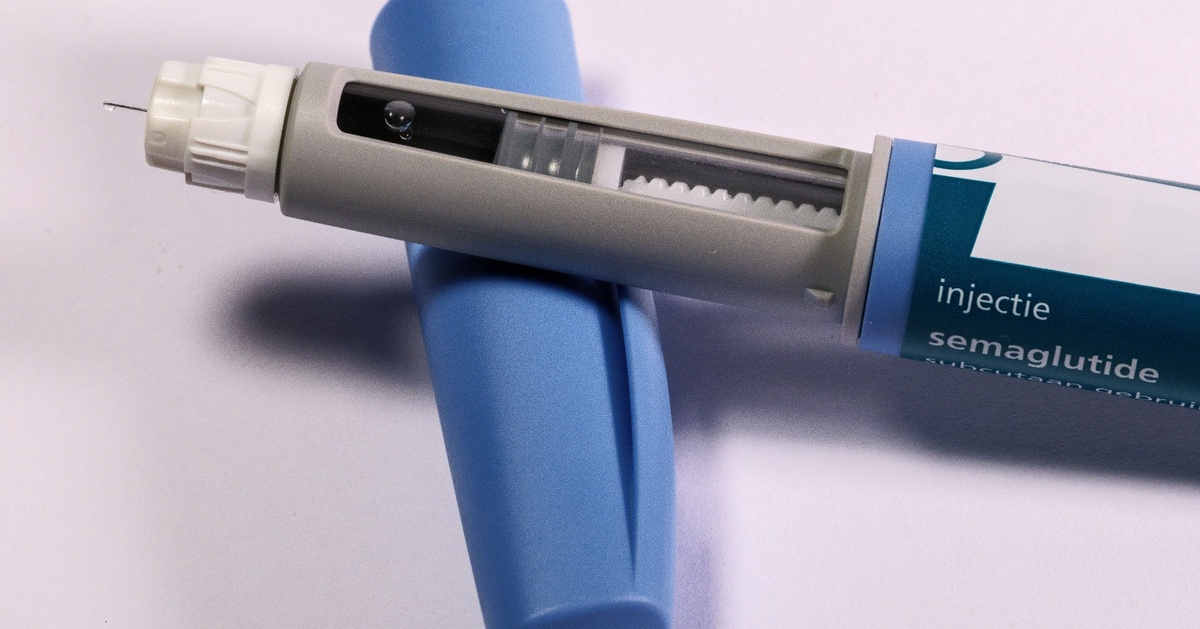
After consulting my physician, I decided to go with tirzepatide, which in his experience was better tolerated than semaglutide.
The first weekly shot was nothing: I’ve had bug bites that hurt more.
3 days later, I had to excuse myself due to a wardrobe malfunction. I remember thinking, “I thought I was supposed to watch for nausea and constipation…”
Not only is diarrhea relatively common (about 1 case in 5), side effects can show up days, even weeks later.
Thankfully, things settled down quickly.
But 20-ish percent of users having significant side effects, even temporary, is significant; nausea occurs almost twice as often. Most medications have side effect associations in the low single digits.
For me, the only thing making those odds worth chancing is the morbidity associated with the alternative (increasing obesity and its downstream health risks).
4. GLPs are not for everyone
The actor Mayim Bialik recently described major side effects when she tried a GLP agent. Not, “I can live with that for a few days while my body adjusts” side effects. Could not function while feeling awful side effects.
“To say I had an adverse reaction would be somewhat of an understatement,” she wrote. “Explosive, uncontrollable diarrhea. Sulfur burps so violent they left me afraid to open my mouth in public. Sneezing attacks every time I tried to eat or drink — which apparently has a name, snatiation. Cramping. Bloating. Full-body aching, as though I had the flu. And an inability to keep down even small sips of water without sprinting to the bathroom with yet more explosive diarrhea. More than three times, I didn’t make it.”
If certain negatives happen, even if they’re not life-threatening, that’s a hard no, and everyone has their list of what these would look like.
And like any medication that fundamentally readjusts the body’s function, severe side effects, though very rare, can occur, including blindness (approximately 1 in 10,000 semaglutide users) and death from gallstone or pancreatitis complications.
The potential benefits are impressive, including a significant reduction in all-cause mortality, but only if you can tolerate the medication.
5. Your food supply will go about twice as far
Food costs are boggling my mind, but mine suddenly dropped by about 50%.
I would order my usual take out, but realized within the first month that I would only eat — could only eat — about half my usual. Half a sandwich instead of a full sammich with chips. A modest dinner, but half saved for lunch the next day, and so on.
GLP agents mainly work by reducing the amount of food you take in. I stopped my habitual foraging for snacks after meals, and started feeling almost full most of the time.
The between meal food noise disappeared, what in Korean is called ibishimshim, “my mouth is bored.” The prompting to get up and graze the snack bin or fridge disappeared.
Not from nausea. More from that feeling when someone asks if you’d like more of a main meal, and you wave your hands frantically NO because you are oh-so-very-done with eating.
And if I went ahead anyway out of habit, I did not feel good.
No reward for grazing, plus some negative feedback for pushing it = major reduction in caloric intake, what the Scientific American study noted is the only real way to lose weight.
6. Your needs will double for quality, nutrient-dense foods
The flip side of eating less — yay, it’s finally actually happening! — is that the intake of everything else drops by the same amount.
You’re cutting more than calories.
The intake of protein, healthy fats, minerals, fiber, and all manner of beneficial cofactors drops, too. There have been cases of severe muscle wasting, neurological complications related to B vitamin deficiency, anemia, and measurable deficiencies in vitamin D.
Overall, my intake hasn’t dropped 50% overall, and long-term studies bear this out. On average, study subjects ate about 300 calories a day less than usual, which doesn’t sound like much until you realize this is reliably sustainable, and translates into an average 5 pound drop every month. That’s 30 pounds of bankable weight loss in 6 months, and often more.
The point is, unless you are careful, you will consume significantly less overall, and that means less of other macro and micro nutrients. If like many Americans you are already behind in vitamin D and fiber, and if older than 60, protein to maintain healthy muscle mass, further cutbacks may do worse things than make you look like a lollipop.
Translation: what you DO eat has got to be chock-full of nutrients.
7. Protein and resistance training are a must
A decent starting point is protein adequacy. Preferably from nutrient rich, not ultraprocessed food sources (animal protein gets the bioavailability nod, here).
As a 60-something aiming to drop to 190 pounds while building active muscle and minimizing my injury risks doing Gracie jiu-jitsu, I’m aiming for about 185-190 grams a day, and no less than 130 grams (about 70% of the target). That’s about 5 oz of meat or 3 whole eggs plus a goodly glob of egg whites for each of 3 daily meals. A lot on any day, but particularly when you’re pushing away from the plate early.
But increased protein intake combined with resistance training are the only reliable ways to counteract a loss in muscle, which is already happening in an accelerated way when you’re older than 40. And protein sources from seafood or “snout to tail” from land animals (more collagen and organ meats) are rich in many micronutrients.
Prioritizing protein intake and strength work was important enough before, to prevent sarcoplasmic shriveling. It’s critical when your meal volumes drop 10-50%.
8. If you’re already working out, you’re in for a nice surprise
Namely, abs.
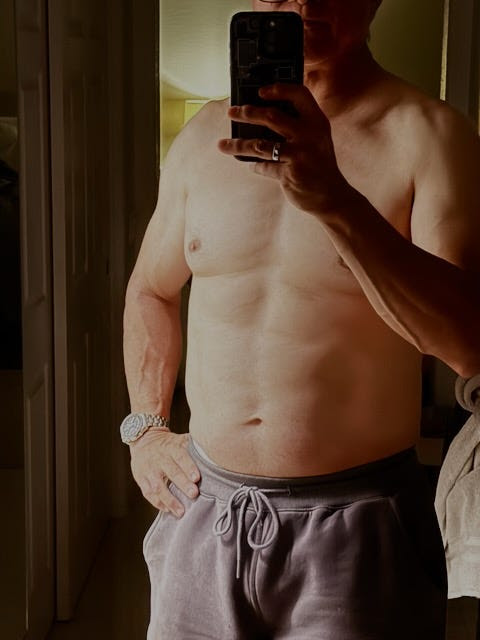
If you always knew they were “just underneath the surface,” loss of subcutaneous fat will reveal them, as well as veins in your arms any bodybuilder would be proud of.
There’s a palpable downside to fat loss that no one is talking about: less cushioning. Bony prominences like the sit bones and tailbone in your butt may become more tender on hard surfaces, and certain nerves like your funny bone nerve (ulnar) in your elbow become more exposed and prone to irritation and tingling.
Again, from a health standpoint, the big GLP win is fat loss from the midsection, where the more dangerous visceral fat lives in and around your liver, intestines, and heart. It drops at least as much as the relative drop in subcutaneous fat, and some studies suggest it may happen proportionately more.
9. Standard diet reveal: wtf?
Pulling back to the bigger picture, what does this all say about our eating habits and food supply?
For most of us, achieving and maintaining a healthy weight means eating much less than we’re used to. But knowing this, even knowing exactly how to do it, we’re still unable to get there despite trying our darnedest.
Americans didn’t used to be generally obese, and say what you will about politics, smarts, and what ARE they teaching kids in school these days, we have not AS A SPECIES suddenly lost the self-control gene.
To me that points to environment, our social surroundings, as the culprit.
Our most readily available foods, to which we default thanks to our previously unimaginably complex digital lives, are fattening us up. And the influences to continue doing so are so pervasive and ubiquitous that most of us are unable to reverse course, without something like a GLP kill switch that offsets these influences at the cellular level.
You know an oil fire is bad when you need a bomb to blast away the oxygen to put it out.
The answer isn’t GLPs. Just like the problem isn’t really obesity.
The problem is what’s causing the obesity epidemic: cheap, irresistibly engineered frankenfoods and an informational society that thrives on overloading our brains.
Healthier food portions and options… cost more, take more time and energy to prepare, and don’t give the same dopamine hit as the nom-nom of melted cheese, savory sauce, and umami carbonized carbs. It’s all up hill to get to the payoff in health longevity, when many of us haven’t preserved any kind of mental bandwidth to make the tougher food choices.
GLPs demonstrate what’s possible, and how much to cut to get there.
Action items
Consider:
If we eat less without eating right, the word malnourishment will re-enter our vocabulary in a way we haven’t seen in nearly a century.
What does eating right look like, with or without GLPs? Sizable protein at every meal, preferably NOT relying on protein powders. Cutting out ultraprocessed foods, and going easy on the sweets and starchy carbs. A wide variety of nutrient dense vegetables and fruits for omnivores.
Plus, avoiding food that’s culinary crack cocaine. If it makes your mind shut off while you roll your eyes in ecstasy, you’re going to overeat, and you’re going to do it again, man.
If a patient of mine was so jammed up that they needed a vacation in the form of lasagna plus 3 slices of cheesecake, I’d tell them what I’d tell someone self-medicating with a bottle of scotch after work.
If something is driving you to a self-destructive escape, cutting out the booze is a great start… but really, you need to subtract that something from your life. Or at least adjust your attitude.
Just because life tosses you balls of poop doesn’t mean you have to pick them all up.
Written by Peter Beck Kim, MD. Reprinted with permission.
Dr. Peter “Beck” Kim, MD is a family medicine physician based in Costa Mesa, California, with over 30 years of clinical experience. Since 1995, he has practiced at Family Care Centers, Medical Group, Inc./Coastal Family Medicine, serving patients in Orange County LinkedIn. He is recognized as a “Top Doctor” by the Orange County Medical Association and Orange Coast Magazine, honored for excellence in patient care, community service, and leadership LinkedIn.
Substack: https://drpbkim.substack.com/
Previous posts online at https://drpbkim.com/all-articles/