
“We have a brain for one reason and one reason only, and that’s to produce adaptable and complex movements.” – Dr. Daniel Wolpert, Neuroscientist. TED Talk, TEDGlobal 2011.
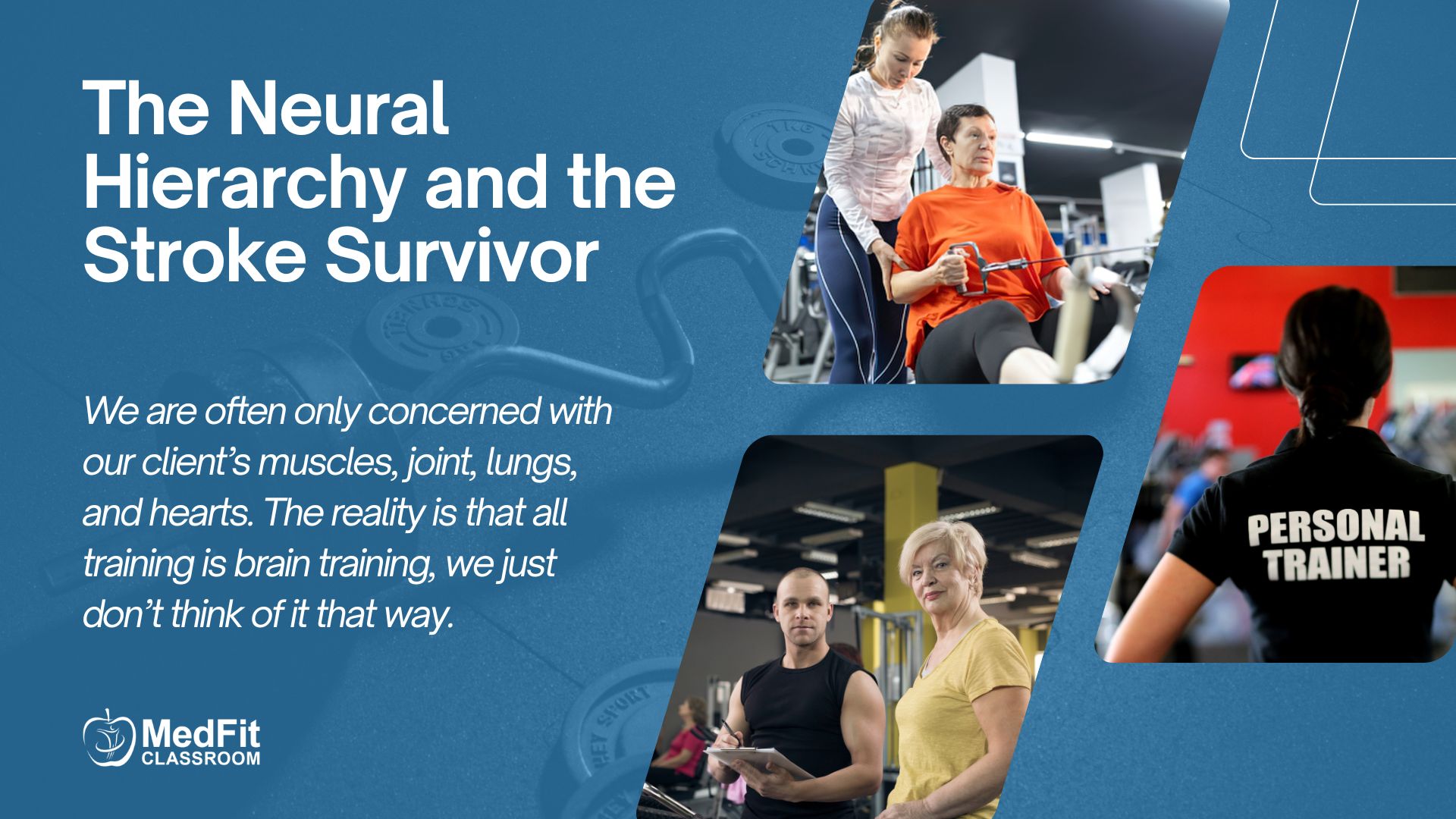
The above quote may come as a surprise. As we are often only concerned with our client’s muscles, joint, lungs, and hearts. The reality is that all training is brain training, we just don’t think of it that way.
We use our brains for many other complex tasks such as making music, language, contemplating physics, problem solving, etc. But all those cognitive actions of the brain are actually secondary to the primary role of producing adaptable and complex movements. This is why brain injuries or diseases like stroke or Parkinson’s so profoundly affect a person’s ability to move.
As a trainer working with stroke survivors, understanding and utilizing the Neural Hierarchy for movement can significantly improve your client’s progress.
What is the Neural Hierarchy?
“Movement is reliant on pattern recognition and prediction — the brain recognizes a pattern of neural activation and knows the right way to respond. While all systems of input are important to movement, the three primary systems we use to gather information for movement prediction are the visual system, vestibular system, and proprioceptive system.” – Dr. Eric Cobb, Z-Health Performance Solutions
Let’s use a GPS analogy. Your brain is like the GPS in your car or phone. For the GPS to provide an accurate location, it needs satellites to triangulate your position. Your “satellites” that provide this information to your brain are the visual, vestibular, and proprioceptive systems.
If one or more of your satellites is not sending good information, the GPS (your brain) has a less accurate reading on your position which results in less-than-optimal movement, balance, coordination, and can even cause pain.
With regards to importance to your brain for movement, the hierarchy of these systems is:
- Visual – Our orientation to the external environment
- Vestibular – Our orientation to gravity, and directional movement
- Proprioception – Our brains’ 3D map of our body in time and space
Why the Neural Hierarchy matters for stroke survivors
Although some stroke survivors can experience non-movement related issues, such as aphasia, the vast majority are dealing with some limitation to their ability to move or their quality of movement.
The first reason using visual, vestibular, and proprioceptive training with stroke survivors is because you can target the areas of their brains that have been affected by the stroke:
- Vision training can affect the occipital lobe, parietal lobe, temporal lobe, frontal lobe, cerebellum, and brainstem
- Vestibular training has impact on the parietal and insular lobes, and can highly activate the cerebellum and brainstem
- Proprioceptive training has a large bearing on the parietal and frontal lobes, as well as the insular lobe and brainstem
The second reason for using the neural hierarchy as part of stroke survivor fitness is the large amount of input to the brain of these systems. So even if the client has very limited movement, much of this training can be done without the requirement for large movements. We can create a high degree of neuronal stimulus by doing drills and exercises that stimulate the visual, vestibular, and proprioceptive systems.
Understanding the Neural Hierarchy and how to harness it is not only for stroke recovery, but also for general fitness, performance, and pain clients! Begin learning a neuro-centric approach to medical fitness and how to work with stroke survivors with our Stroke Recovery Fitness Specialist online course.
- MedFit courses are 100% online and self-study. Complete at your own pace.
- Payment plan available,
- Approved for CEUs by ACE, AFAA, NASM and canfitpro. *ISSA trainers can submit their certificate in their ISSA portal for credit approval.