
Part I: Overview and Pathophysiology of Alcohol Use Disorder
Alcohol Use Disorder (AUD) may not be the first condition that comes to mind when discussing chronic conditions where exercise can provide substantial benefit. Yet, there is considerable evidence to support the idea that exercise therapy can prove quite beneficial in recovery from AUD Approximately 17.6 million Americans are diagnosed with alcohol addition or dependence each year. Likewise, AUD, like eating disorders, is a chronic condition that must always be managed as relapse occurs in 60-90% of patients (Brown et al.,2009).
Pathophysiology
Alcohol primarily triggers the release of dopamine in the brain which promotes reward-based learning thereby creating the possibility for addiction. Alcohol is also a central nervous system depressant. Likewise, it binds to glutamate receptors, specifically the N-methyl-D-aspartate receptor (NMDA). Chronic exposure to high volumes of alcohol causes the body to adapt by upregulating these receptors. However, the NMDA receptors act as stimulants which, when the individual withdraws from alcohol, can cause agitation, tremors and even tachycardia, fever and seizures when there is a large surplus of these receptors (Clapp et al., 2014).
Alcohol, consumed chronically in excess, is toxic to the liver, pancreas and bone marrow. Liver/pancreatic inflammation, anemia, dyslipidemia, protein deficiency are common findings. Similarly, many patients with alcoholism suffer from malnutrition due to chronic consumption of high volumes of alcoholic beverages instead of food in addition to interference with absorption of nutrients in the gastrointestinal tract. Malnutrition leads to both macro and micronutrient deficiencies resulting in cerebral atrophy, memory deficiency and congestive heart failure (World et al., 1985).
Recovery from Alcohol Use or Addiction Disorder
Recovery from AUD spans long after the initial withdrawal from the drug. Alcoholism is a long-term diagnosis and must be treated as a chronic condition always requiring management.
Detox/Withdrawal Process. Withdrawal from alcohol can be life-threatening if not managed appropriately. Initially, the patient is often treated with benzodiazepines (i.e., Librium, Ativan, Valium) to stimulate central nervous system depression as stimulant receptors will be greatly upregulated . Withdrawal symptoms such as tremors on the milder end to seizure, fever and tachycardia on the more severe end will typically appear within 72 hours of abstaining from alcohol. Symptoms can persist up to 2-3 weeks. During that time, benzodiazepines will be weaned until the patient is fully withdrawn. This process should occur under medical supervision. The patient can begin an exercise program after this process is complete with the clearance of a physician (Mirijello et al., 2015).
Exercise Therapy for Individuals in Recovery from Alcoholism
Exercise can be extremely therapeutic for individuals in recovery from alcoholism. Exercise therapy can assist patients in recovery from alcoholism both psychologically and physiologically by using a variety of exercise modalities. There are several aspects of the sequelae that follows initial withdrawal from alcohol where exercise proves beneficial. However, the fitness professional must pay close attention to these considerations when designing programming (Manthou et al., 2016).
Part 2: Medical Co-Morbidities and Training Considerations
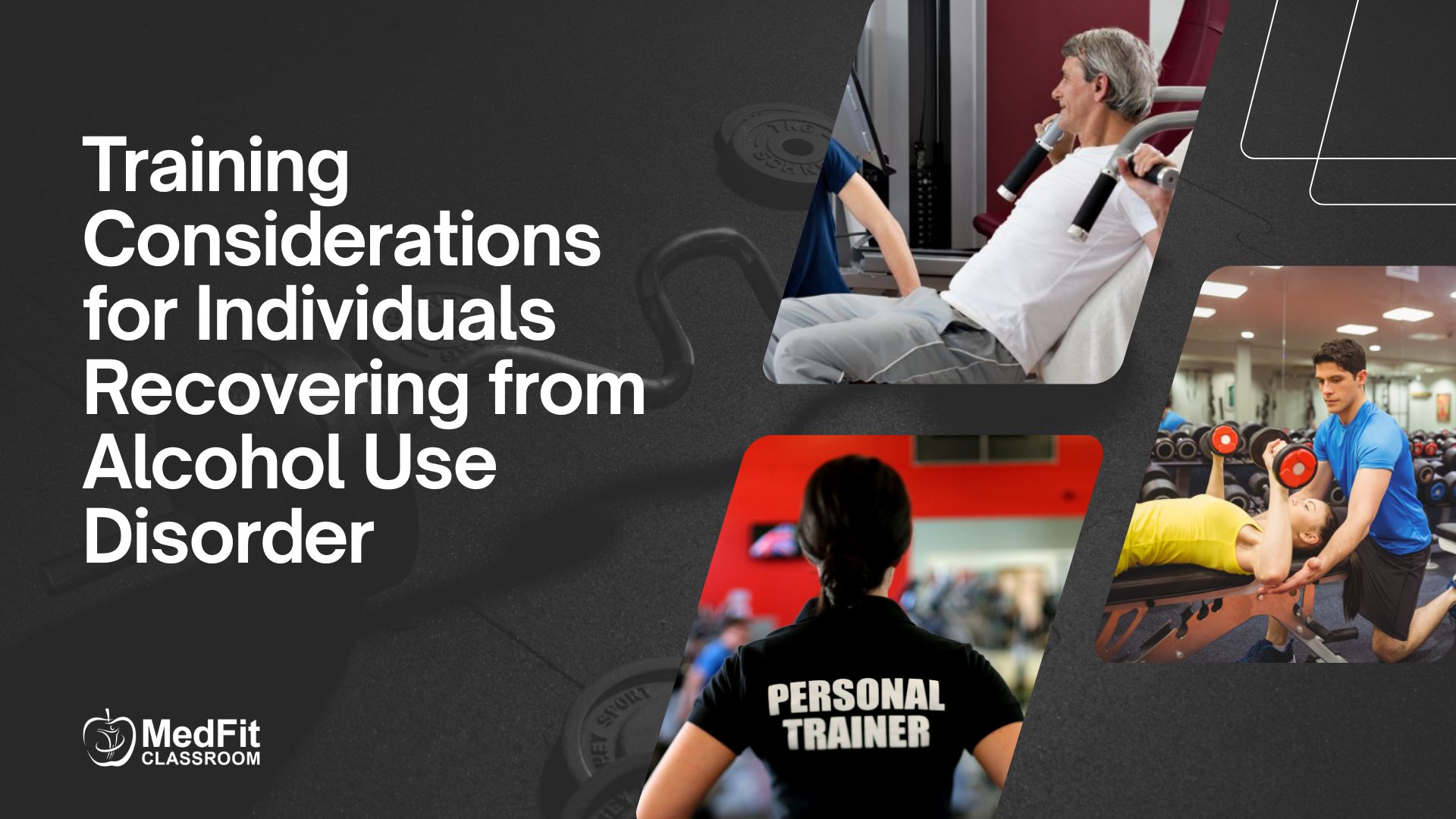
A history of Alcohol Use Disorder (AUD) poses a set of challenges for the fitness professional working with this population. Clients affected by AUD can benefit greatly from working one-on-one or in a group setting, however, specific medical co-morbidities must be considered when designing programming for and working with individuals in this population.
Weakness/Muscle Wasting
Malnutrition, specifically protein deficiency, and low levels of physical activity can cause the individual to have significantly reduced muscle mass as alcohol adversely affects anabolic and catabolic processes in the body. Additionally, high volumes of alcohol consumption lead to a decrease in the function of muscle progenitor cells reducing the body’s ability to rebuild damaged muscle tissue (Simon et al., 2017).
Alcoholic myopathy can present as an acute or chronic case. Chronic alcoholic myopathy is rare in individuals under the age of 30 and most common in individuals between the ages of 40 and 60 years who have a long-term history of alcohol abuse (Simon et al., 2017). Clients in the training setting affected by alcoholic myopathy will present with the chronic form. Aerobic and strength training has been shown to improve muscle endurance and maximal oxygen uptake in patients with alcoholic myopathy, but training regimens must be moderate in intensity and clients should be closely supervised. High-intensity activity should be avoided (Brown et al., 2014). Likewise, consultation with a registered dietician is recommended to optimize nutrition intake for these clients.
Poor Coordination
Long-term alcohol abuse can lead to impairments in cognition and motor coordination. Although poor cognition and motor coordination improve as the patient recovers, there may be some lingering effects. There is little research specifically targeting enhancing proprioception and cognition through exercise in this population, however, proprioceptive training has been found to improve these markers in the elderly, stroke patients and in otherwise healthy adults (Linke & Ussher, 2014). Rooge et al. (2017) conducted a trial with 70 sedentary adults and found that there was an average of a 52% increase in all markers of cognitive function and spatial awareness for participants (Rogge et al., 2018).
It is important for the fitness professional to understand limitations that may stem from poor motor coordination in these clients. A thorough fitness assessment including balance assessment such as the Berg Balance Scale should be included when starting with a client recovering from AUD. Additionally, these individuals may also benefit from an extended stabilization phase of training with progressions introduced slowly (Sanders, 2014).
Reduced Aerobic Capacity
Physician clearance for exercise is critical in this population, however, it is important for the fitness professional to note that the client may have longer-lasting organ dysfunction leading to the need for exercise modifications. Liver inflammation and dysfunction of the pancreas and kidneys and congestive heart failure are possible long-term effects of AUD. Kidney dysfunction can lead to anemia and electrolyte disturbance decreasing aerobic capacity and contractile strength and frequency of working muscles during exercise. Likewise, congestive heart failure can considerably decrease aerobic capacity via limited capability for the circulatory system to pump blood to working muscles (Osna & Kharbanda, 2016). Likewise, the client may be deconditioned from lack of physical activity at baseline or nutritional disturbances.
The fitness professional should be aware of these potential conditions and modify exercise accordingly. However, exercise can be quite beneficial for individuals with organ dysfunction as a result of AUD such as reducing the hepatic pressure gradient in those with cirrhosis of the liver (Locklear et al., 2018). Low to moderate exercise intensity is recommended in this population. Tests to estimate VO2 max are recommended for this population, though graded assessments are contraindicated. The 6-minute walk test or 3-minute step tests can be safe effective methods for determining VO2 max for clients with these potential comorbidities (Pollentier et al., 2010). They should be conducted upon initial assessment of the client and repeated periodically to check for improvements before increasing exercise intensity.
Part III: Less Obvious Medical/Psychological Co-Morbidities
Oftentimes, we may consider co-morbidities such as malnutrition, muscle wasting, reduced aerobic capacity, and motor disturbances when working with individuals with a history of Alcohol Use Disorder (AUD). However, there are other considerations that may be less obvious, but of equal importance when designing exercise programming for members of this special population.
Prior Orthopedic Injuries
Chronic alcohol consumption can lead to poor decision-making and puts users at a higher risk of orthopedic traumas. In fact, Nordqvist and Petersson (1996) investigated 413 shoulder injuries in a retrospective study and found that shoulder injuries were four times as likely in patients with AUD than otherwise healthy adults (Nordqvist & Petersson, 1996). Likewise, Levy et al. (1996) conducted a retrospective study of patients admitted to their orthopedic services between 1993 and 1994. The investigators found that patients with open fractures, patients involved in pedestrian versus motor vehicle collision and gunshot victims had a 25% positive screen rate for alcohol (Levy et al., 1996).
A variety of orthopedic traumas are possible in this population which could lead to significant movement imbalances and the necessity to modify training plans. The fitness professional must take a careful history to determine which injuries the client may have sustained in the past and plan training programs accordingly.
Psychological Considerations
Exercise is perhaps most beneficial to alleviate some of the psychological effects of AUD. A consistent exercise program can increase self-efficacy, decrease the urge to drink, improve mood, provide a pleasurable state without the use of alcohol and serve as a replacement behavior for drinking (Brown et al., 2008). Similarly, Brown et al. (2009) found that participants who engaged in a 12 weeks exercise program while in recovery showed significantly lower rates of relapse than subjects who did not participate in the program (2009). However, several studies conducted to determine the efficacy of training programs at reducing relapse of AUD found that ongoing follow-up and supervised programs are more likely reduce the incidence of relapse (Manthou et al., 2016). The fitness professional can provide support with regards to adherence to exercise programs and the formation of the exercise habit. The trainer must also be aware of this and provide positive emotional support and coaching accordingly.
Conclusion
An individual in recovery from AUD may experience poor gross motor coordination and proprioception, muscle wasting due to malnutrition and poor aerobic endurance. However, exercise programs have been demonstrated to be greatly beneficial to these clients both physiologically and psychologically. The fitness professional must be aware of potential contraindications to types of exercise and intensity of exercise. The trainer must receive medical clearance for exercise, complete an extended assessment process and careful history prior to planning a training program for individuals in this population. Overall, individuals in recovery from AUD can be a rewarding population to work with and can engage in exercise programs safely and effectively.
Online Course: Drug & Alcohol Recovery Fitness Specialist
Arm yourself with the knowledge & tools to build successful fitness programming for drug and alcohol recovery.
Substance Use Disorder affects a huge number of individuals. More than 20 million Americans are diagnosed with Substance Abuse Disorder. Research has demonstrated that exercise therapy can help these patients a great deal from improving long-term neurological outcomes to relapse prevention. There are physiological and psychological considerations you must understand to design and implement successful exercise programs for this population.
MedFit Classroom’s online course, Drug and Alcohol Recovery Fitness Specialist, will teach you what you need to know.
Written by Nicole Golden. Nicole Golden, MS is a NASM Master Trainer, CES, BCS, FNS and AFAA certified group fitness instructor . She has been a health/fitness professional since 2014 when she left the field of education to pursue a full-time career in fitness. Nicole is the owner of FWF Wellness where she specializes in corrective exercise, weight loss coaching, nutrition coaching and group fitness. She holds a Master of Science in Applied Exercise Science/Sports Nutrition.
References
- Brown, R. A., Abrantes, A. M., Minami, H., Read, J. P., Marcus, B. H., Jakicic, J. M., Strong, D. R., Dubreuil, M. E., Gordon, A. A., Ramsey, S. E., Kahler, C. W., & Stuart, G. L. (2014). A preliminary, randomized trial of aerobic exercise for alcohol dependence. Journal of Substance Abuse Treatment, 47(1), 1–9. https://doi.org/10.1016/j.jsat.2014.02.004
- Brown, R. A., Abrantes, A. M., Read, J. P., Marcus, B. H., Jakicic, J., Strong, D. R., Oakley, J. R., Ramsey, S. E., Kahler, C. W., Stuart, G. G., Dubreuil, M. E., & Gordon, A. A. (2009). Aerobic exercise for alcohol recovery: Rationale, program description, and preliminary findings. Behavior Modification, 33(2), 220–249. https://doi.org/10.1177/0145445508329112
- Clapp, P., Wackernah, R., & Minnick, M. (2014). Alcohol use disorder: Pathophysiology, effects, and pharmacologic options for treatment. Substance Abuse and Rehabilitation, 5, 1. https://doi.org/10.2147/sar.s37907
- Manthough, E., Geogakouli, K., Fatouros, I. G., Gianoulakis, C., Theodorakis, Y., & Jamurtas, A. Z. (2016). Role of exercise in the treatment of alcohol use disorders. Biomedical Reports, 4(5), 535–545. https://doi.org/10.3892/br.2016.626
- Mayo Clinic. (2018). Alcohol use disorder – Diagnosis and treatment – Mayo Clinic. Mayoclinic.Org. https://www.mayoclinic.org/diseases-conditions/alcohol-use-disorder/diagnosis-treatment/drc-20369250
- Mirijello, A., D’Angelo, C., Ferrulli, A., Vassallo, G., Antonelli, M., Caputo, F., Leggio, L., Gasbarrini, A., & Addolorato, G. (2015). Identification and management of alcohol withdrawal syndrome. Drugs, 75(4), 353–365. https://doi.org/10.1007/s40265-015-0358-1
- World, M. J., Ryle, P. R., & Thomson, A. D. (1985). Alcoholic malnutrition and the small intestine. Alcohol and Alcoholism (Oxford, Oxfordshire), 20(2), 89–124. https://www.ncbi.nlm.nih.gov/pubmed/4052163