
Walk into almost any gym, and you’ll see a familiar pattern. People who are already relatively healthy… working to get fitter. But what about the people who aren’t?
The reality is that the fitness industry has unintentionally built itself around a population that represents only a fraction of those who could benefit from exercise.
Meanwhile, the majority – those living with chronic disease, medical conditions, or age-related challenges – are often left without the support they need.
The Reality: Most People Are Not “Apparently Healthy”
According to the Centers for Disease Control and Prevention, 6 in 10 adults in the United States live with at least one chronic disease, and 4 in 10 live with two or more.
That means the typical client is not injury-free, pain-free or disease-free.
They may be managing:
- Arthritis
- Cardiovascular disease
- Diabetes
- Neurological conditions
- Cancer recovery
- Chronic pain
And yet, most fitness environments (and most fitness education) are not designed with these individuals in mind.
Who Are the Most Underserved Clients?
1. Individuals Living with Chronic Disease
This is the largest and most overlooked group.
Exercise is one of the most effective tools for managing chronic conditions, yet many individuals are:
- Unsure what is safe
- Afraid of making symptoms worse
- Lacking access to qualified professionals
The World Health Organization identifies physical inactivity as a leading risk factor for global mortality.
These clients don’t need less exercise. They need better guidance.
2. Post-Rehabilitation Clients
After completing physical therapy or cardiac rehab, many individuals are told, “You’re cleared for exercise.”
But then what?
There is often a massive gap between discharge and real-world fitness environments. Without proper support:
- Progress stalls
- Confidence drops
- Risk of regression increases
These clients need professionals who can bridge the gap between rehab and independence.
3. Older Adults
As the population ages, this group is growing rapidly but remains underserved.
Older adults often face decreased strength and balance, increased fall risk and multiple health conditions.
According to the National Institute on Aging, regular physical activity is critical for maintaining independence and reducing fall risk.
This is not a niche. This is the future of fitness.
4. Individuals with Chronic Pain or Mobility Limitations
Many clients live in a constant cycle of Pain → Avoidance → Deconditioning → More Pain
Without knowledgeable guidance, exercise can feel intimidating, or even unsafe.
The American College of Sports Medicine supports appropriately prescribed exercise as a key strategy for improving function and reducing pain in many populations.
These clients don’t need intensity—they need intelligent progression.
5. Individuals Who Feel “Out of Place” in Fitness Spaces
This may be the most overlooked group of all. Many people avoid gyms entirely because they don’t see anyone like them, or feel judged or intimidated.
These are often individuals with:
- Medical conditions
- Larger bodies
- Low confidence
- Previous negative experiences
The barrier here isn’t ability. It’s access, environment, and trust.
Why These Clients Are Overlooked
The issue isn’t a lack of compassion. It’s a lack of preparation.
Most fitness professionals are not trained to:
- Work with complex medical conditions
- Modify appropriately
- Recognize red flags
- Communicate with healthcare providers
So they default to avoidance, over-simplification, or overly cautious programming
The Opportunity (and Responsibility)
This is where the fitness industry is evolving. Because these underserved clients are not a small segment, they are the majority. And they are looking for safety, guidance, confidence, and support.
When fitness professionals step into this space:
- They expand their impact
- They differentiate their careers
- They become part of the healthcare continuum
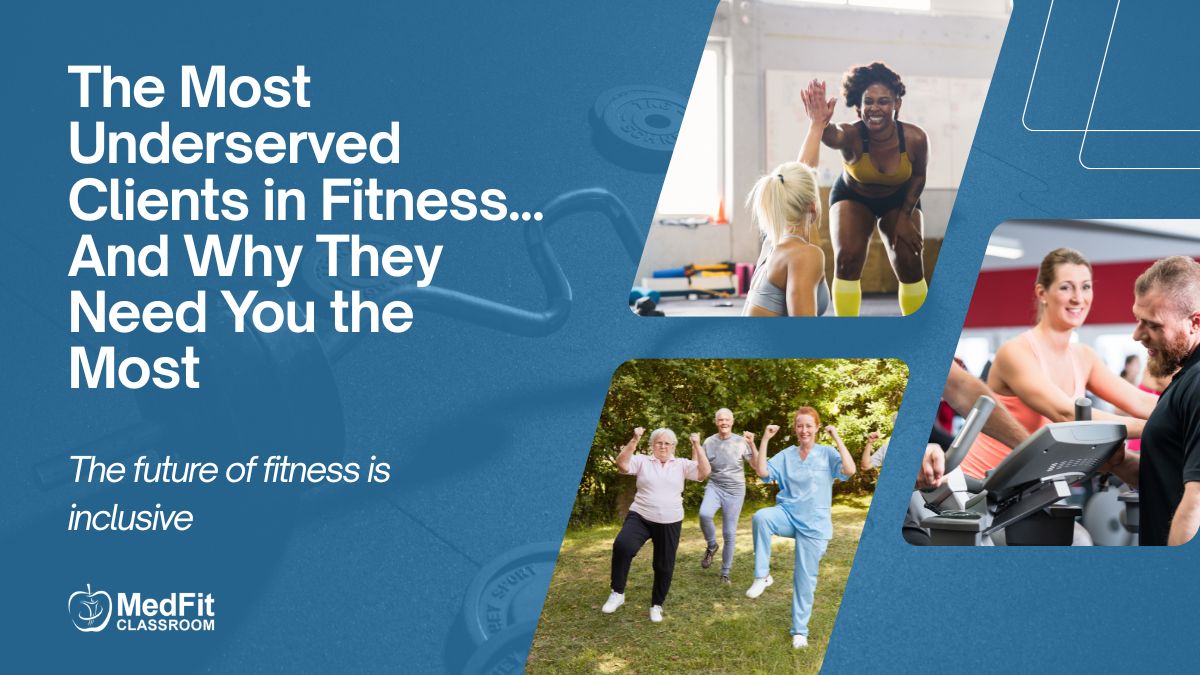
The Future of Fitness Is Inclusive
The future of fitness isn’t about serving the already fit.
It’s about reaching:
- The individual managing diabetes
- The cancer survivor rebuilding strength
- The older adult trying to stay independent
- The client who is afraid to walk into a gym
Because those are the people who need you most.
Your Next Step
If you’re ready to expand your skillset and confidently work with underserved populations, MedFit Classroom offers online specialist courses designed to help you bridge the gap between fitness and healthcare:
Because the future of fitness isn’t just about performance. It’s about accessibility, inclusivity, and impact.