
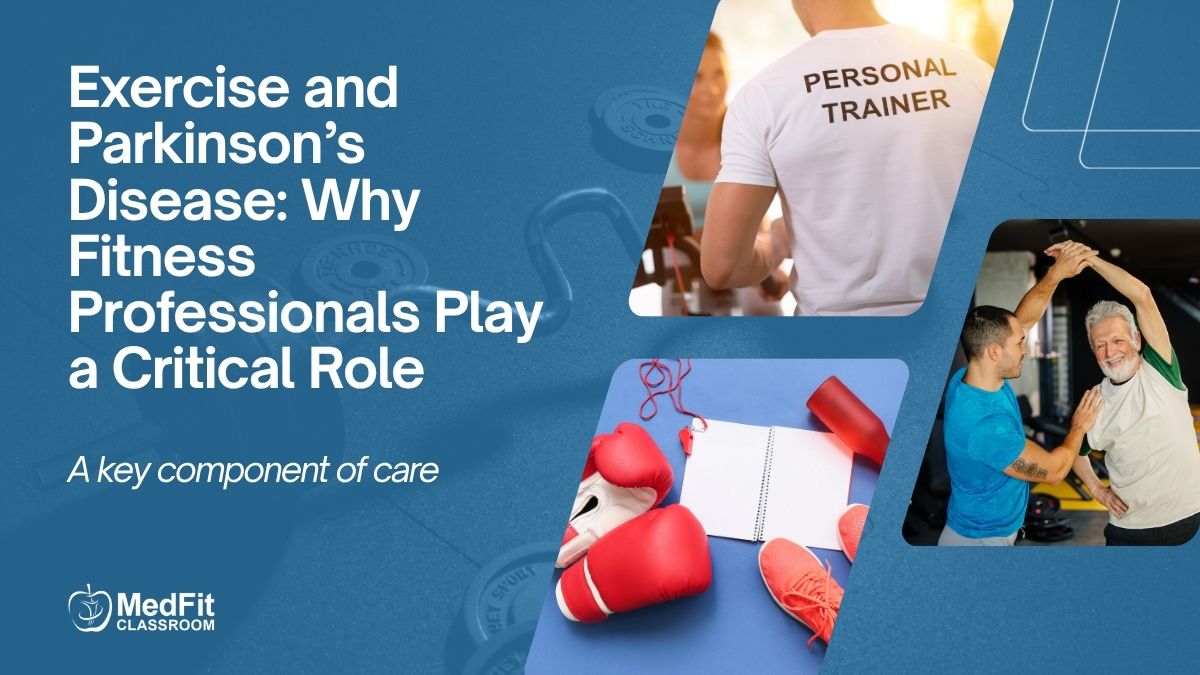
April is Parkinson’s Awareness Month, a time to elevate understanding of a condition that affects nearly one million people in the United States alone. For fitness professionals, it’s also an opportunity to recognize the powerful role you can play in improving the lives of individuals living with Parkinson’s disease.
Exercise is no longer viewed as “optional” for this population. It is a key component of care.
Why Exercise Matters in Parkinson’s Disease
1. You Can Directly Improve Movement and Function
Parkinson’s disease is characterized by bradykinesia (slowness of movement), rigidity, tremor, and postural instability. Research consistently shows that targeted exercise, especially programs that include strength, balance, and aerobic training—can improve gait, mobility, and overall motor function.(1)
For trainers, this means your work translates directly into helping clients move better, stay independent longer, and maintain confidence in daily life.
2. Exercise Supports Brain Health (Not Just the Body)
Emerging research suggests that exercise may have neuroprotective effects. Moderate-to-high intensity exercise has been associated with improved neuroplasticity and may help slow functional decline in Parkinson’s disease.(1)
This is a powerful shift: you’re not just “training muscles”, you’re supporting brain health.
3. You Can Impact Non-Motor Symptoms
Parkinson’s is more than a movement disorder. Clients often experience anxiety, depression, fatigue, and cognitive changes. Exercise has been shown to improve mood, reduce anxiety, and enhance cognitive function.(3)
For many clients, these benefits are just as meaningful, if not more, than physical improvements.
4. Consistency is Key. That’s Where You Come In.
One of the biggest challenges for individuals with Parkinson’s is maintaining consistency with exercise. This is where fitness professionals are essential.
You provide:
- Structure and accountability
- Safe, progressive programming
- Motivation and confidence-building
- Adaptations as the disease progresses
In many cases, you become a critical extension of the healthcare team.
5. Specialized Knowledge Matters
While general exercise is beneficial, Parkinson’s-specific programming is most effective when it is:
- Intentional (e.g., amplitude-based movements, dual-task training)
- Progressive and adaptable
- Focused on real-world function
Understanding the nuances of Parkinson’s allows you to deliver safer, more effective, and more impactful sessions.
Parkinson’s Awareness Month is a reminder that awareness must lead to action. As a fitness professional, you are uniquely positioned to change the trajectory of someone’s life with Parkinson’s disease.
Exercise is one of the most powerful tools available, and you are the one delivering it.
Ready to Make a Bigger Impact?
If you’re ready to confidently train and support clients with Parkinson’s disease, it starts with the right education.
👉 Learn how to design safe, effective, and Parkinson’s-specific exercise programs with the Parkinson’s Disease Fitness Specialist online course. Use code PDFS50 to save 50% on this specialist course! Ends April 17.
Expand your expertise. Support a growing population. Be part of the future of medical fitness.
References:
- Mak MKY, Wong-Yu ISK, Shen X, Chung CLH. Long-term effects of exercise and physical therapy in people with Parkinson disease. Journal of Parkinson’s Disease.
https://pubmed.ncbi.nlm.nih.gov/28505956/ - da Silva FC, Iop R da R, Domingos dos Santos PD, et al. Effects of physical exercise programs on cognitive function in Parkinson’s disease patients: A systematic review. Movement Disorders.
https://pubmed.ncbi.nlm.nih.gov/29218846/